

Building AI Applications: What Matters in 2026
Building AI applications in 2026 is no longer about shipping a flashy prompt box, calling it “AI-powered,” and hoping the prototype survives real users. The bar is higher now. Founders, indie makers, startups, and product teams want real software: apps with working backends, structured databases, stable APIs, secure environments, and workflows that can evolve after launch.
That is exactly where most AI app projects still break down.
Competitor content around this topic tends to repeat the same broad themes: AI adoption is growing, teams need better workflows, infrastructure matters, and leaders should think beyond experimentation. All true. But most of it stays at the strategy layer. What gets missed is the practical gap between an AI demo and a production-ready AI application.
This article closes that gap.
You’ll learn what actually matters when building AI applications in 2026, where teams waste time and budget, what infrastructure is non-negotiable, and why platforms like Flowdia are gaining traction among builders who are done with half-finished AI toys.
“Only 39% report enterprise-level EBIT impact from AI.” — McKinsey
“Between 60% and 90% of AI projects are at risk of failure by 2026.” — TechRadar
The takeaway is blunt: AI interest is everywhere, but production success is not. That makes execution the real differentiator.
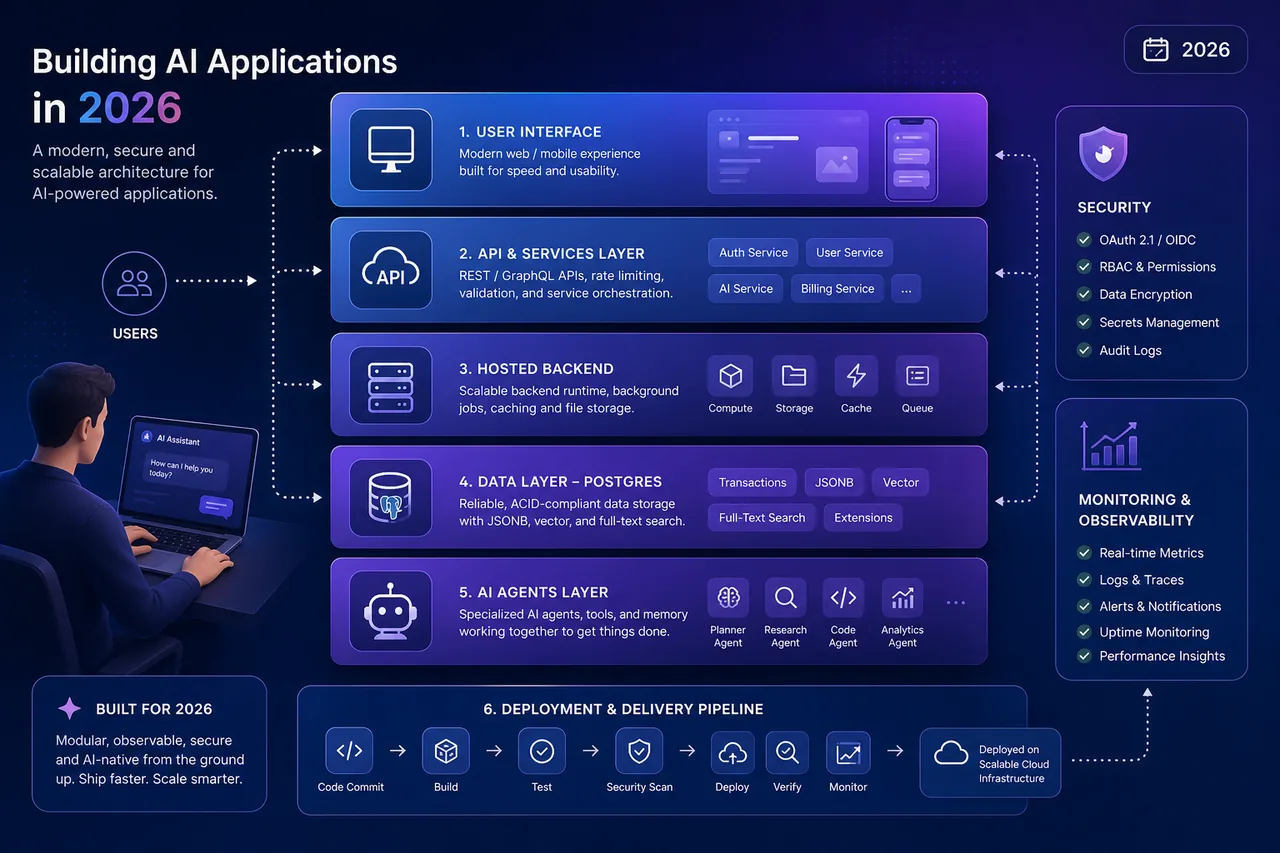
The Real Shift in 2026: From AI Features to AI Products
A year ago, many teams were still asking, “How do we add AI to our app?” In 2026, the better question is:
How do we build an application where AI is only one reliable part of a complete product system?
That shift changes everything.
An AI feature can be impressive in isolation. A production AI product must handle:
- authentication
- data storage
- permissions
- versioning
- model orchestration
- latency
- retries
- observability
- auditability
- deployment environments
- security reviews
- ongoing iteration
This is why so many AI builders disappoint serious users. They generate a nice-looking front end and maybe a little sample logic, but they leave the hard parts scattered across third-party tools, manual setup, and fragile workarounds.
That might be enough for a demo day. It is not enough for a business.
What Competitors Get Right — And What They Usually Miss
The leading articles in this space generally agree on a few things:
| Common Competitor Theme | Why It Matters | What They Usually Miss |
|---|---|---|
| AI is becoming central to business operations | True, adoption is accelerating | Adoption is not the same as deployment maturity |
| Infrastructure matters more than features | Correct | They rarely explain what infrastructure stack is actually needed |
| Change management and workflow redesign matter | Also true | They often ignore how builders need tooling that enforces structure |
| AI should solve real customer problems | Essential | They stop at strategy, not app architecture |
| Monitoring, scalability, and lifecycle management matter | Absolutely | They underplay how difficult this is when the backend is stitched together manually |
The biggest content gap is this:
Most articles talk about AI applications as if the hard part is deciding to build them. In reality, the hard part is building them in a way that still works after version 1.
Prototype vs Production: The Line Too Many Teams Ignore
A lot of “AI app development” is still prototype theater.
Teams create:
- a chatbot front end
- one model call
- a few hardcoded flows
- no real database design
- no stable API layer
- no deployment separation
- no memory across iterations
- no security posture worth trusting
Then they discover the ugly truth: the prototype cannot become the product without a near-total rebuild.
That rebuild is where momentum dies.
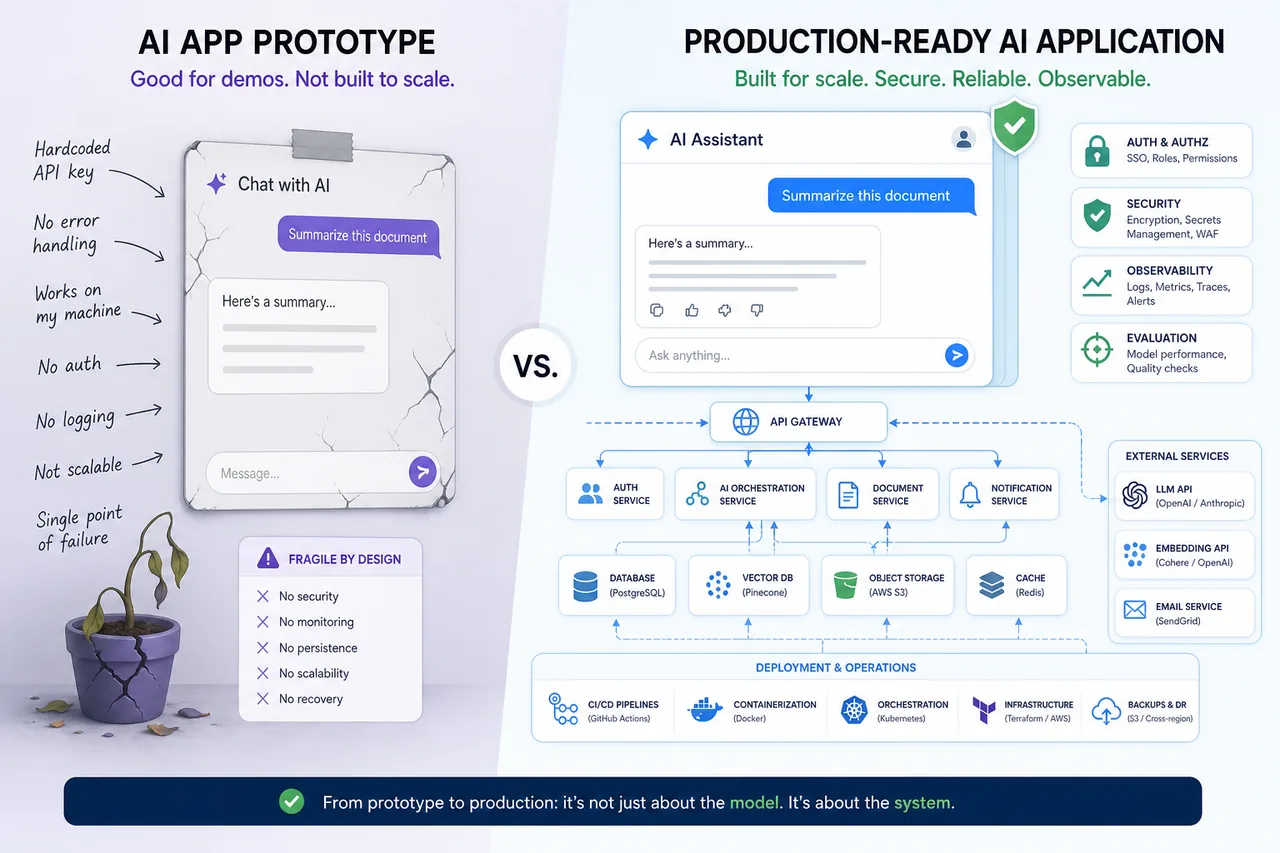
A Prototype Is Not a Product If It Lacks These
1. A real hosted backend
If your app depends on external patchwork services for core logic, it is fragile by design.
2. A dedicated database
You cannot build serious AI workflows without durable structured data. Prompt-only logic breaks fast when users, permissions, app state, and history become real.
3. Stable API endpoints
If the application cannot expose clean interfaces for automation, integrations, and external systems, it has limited business value.
4. Safe deployment environments
You need preview and production environments. Otherwise, every change becomes a risky live experiment.
5. Memory across iterations
If the system forgets prior decisions every session, you are paying repeatedly for context reconstruction.
6. A real product workflow
Good software does not emerge from random prompting. It emerges from planning, design, build, and release discipline.
This is one reason Flowdia’s positioning stands out. It does not pretend a single general-purpose AI can replace an actual app-building process. Instead, it uses a 10-agent specialized AI team mapped to the work real software teams already understand: brainstorming, analysis, product management, UX design, architecture, development, code review, QA, test architecture, and security.
That is not gimmicky. It is closer to how quality software is actually made.
The 8 Things That Actually Matter When Building AI Applications in 2026
1. Problem–Model Fit Comes Before Model Choice
Too many teams start with the model instead of the product problem.
The better sequence is:
- define the user job
- identify where AI creates leverage
- decide whether the AI output is advisory, generative, predictive, or autonomous
- only then choose model architecture and orchestration
Questions smart teams ask first
- Is the AI making suggestions or taking actions?
- Does correctness matter more than creativity?
- Is the workflow synchronous or long-running?
- Do outputs need citations, audit logs, or approval steps?
- What happens when the model is wrong?
In 2026, strong AI products are less about having the “best model” and more about having the right control system around the model.
2. The Backend Is the Product
A surprising number of AI tools still act as though the interface is the app. It is not.
The backend defines:
- business logic
- permissions
- storage
- orchestration
- data transformations
- integrations
- scheduling
- reliability
- recoverability
If you want to build AI applications that survive customer use, your backend must be real from day one.
That is where Flowdia has a meaningful advantage over lighter AI builders. Instead of forcing users to assemble their backend from separate services, it provides a real hosted backend on Flowdia infrastructure, plus a dedicated Postgres database for every app. That dramatically reduces the assembly burden and removes one of the biggest reasons demo projects stall before launch.
Why dedicated Postgres still matters
The current AI conversation often over-romanticizes vector layers and unstructured memory. Those matter, but structured application data still runs the business.
Postgres gives you:
- relational integrity
- transactional consistency
- flexible schema evolution
- predictable query patterns
- mature ecosystem support
For most business apps, that is not optional. It is foundational.
3. AI Apps Need Structured Workflow, Not Prompt Chaos
One of the most overlooked realities in AI app building is that unstructured prompting produces unstructured products.
You can absolutely ideate with freeform prompting. But when you start building software, you need a process.
The best workflow in 2026 looks like this:
| Phase | Goal | Key Outputs |
|---|---|---|
| Plan | Clarify scope, user, workflows, and constraints | product brief, requirements, priorities |
| Design | Define UX, architecture, data model, states | flows, UI direction, schema, system design |
| Build | Implement app logic, backend, database, APIs | working application, endpoints, integrations |
| Ship | Test, review, deploy, iterate safely | preview release, production release, QA feedback |
That is precisely why Flowdia’s Plan, Design, Build, and Ship model is such a strong fit for serious builders. It mirrors actual product development rather than pretending “generate app” is a complete methodology.
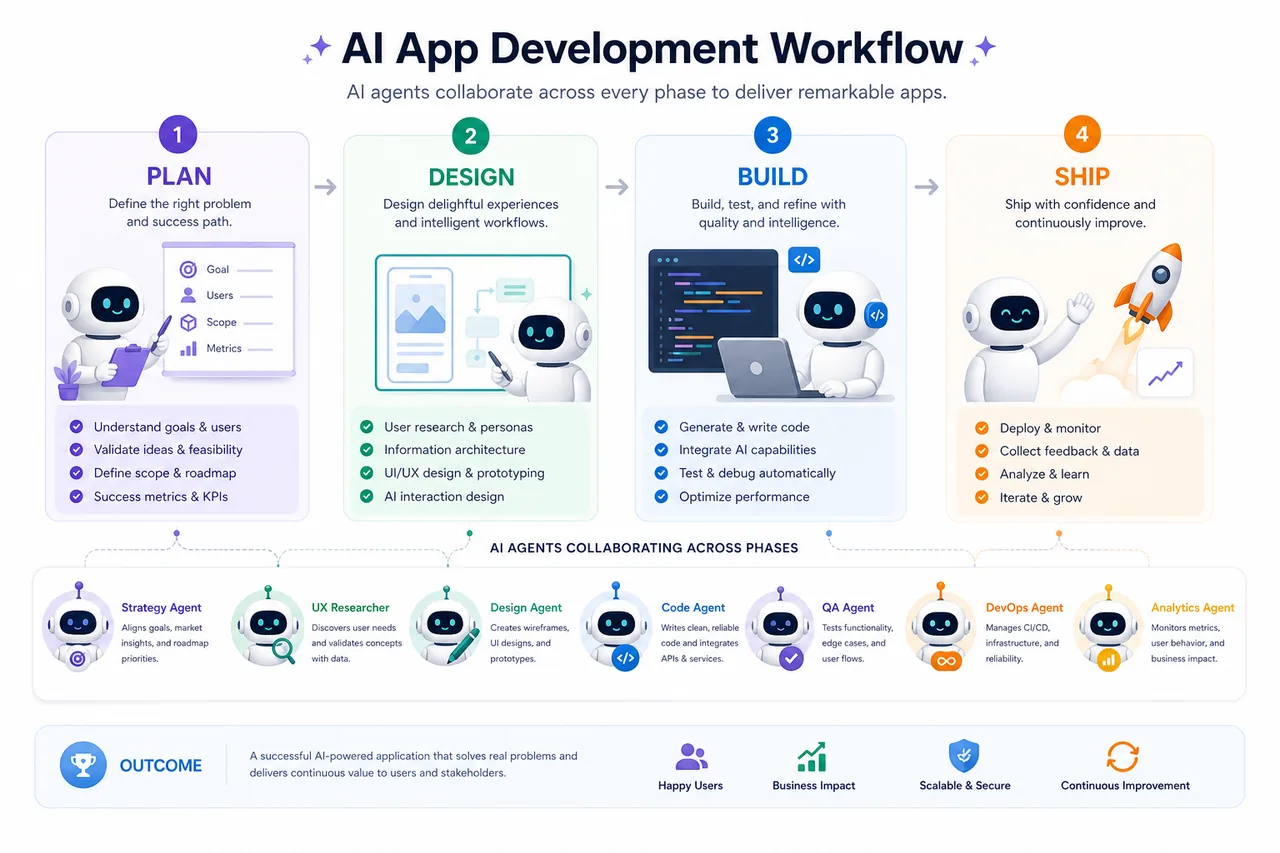
4. Integration Is No Longer Optional
Modern AI applications do not live alone. They sit inside a wider software environment.
That means your app may need to interact with:
- internal systems
- SaaS tools
- customer data sources
- automation workflows
- developer tooling
- AI assistants and coding environments
This is where many no-code and AI builders still feel shallow. They create an isolated artifact instead of a connected product.
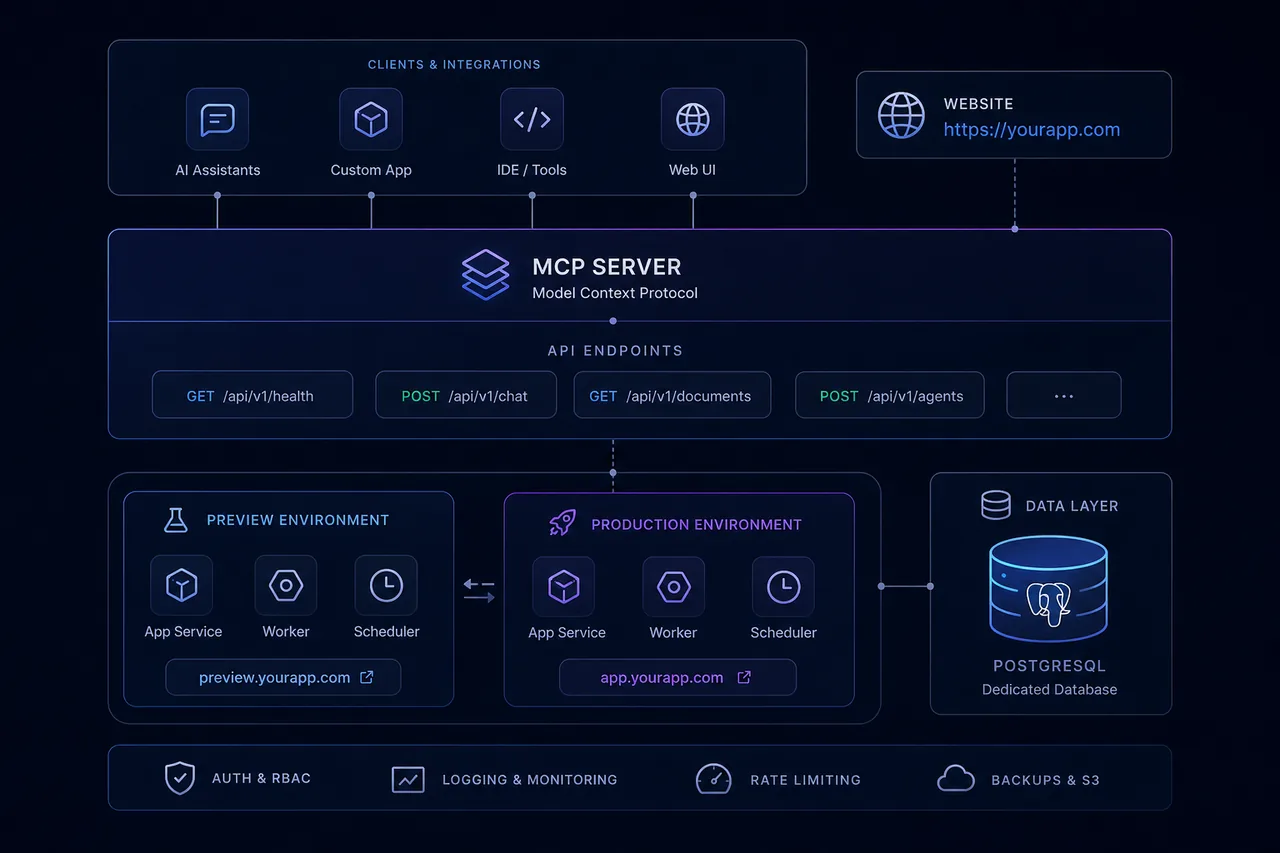
The new standard: app + API + AI-tool compatibility
Serious builders increasingly want:
- a live website URL
- API endpoints
- machine-consumable interfaces for AI tooling
Flowdia leans into this by shipping website, API, and MCP server URLs with each app. That matters more in 2026 than most articles acknowledge.
Why? Because tools like Claude and Cursor are becoming active participants in product development and operations. If your app can expose functionality through MCP-compatible workflows, you are building for the way modern teams actually work — not the way old-school app builders imagine they work.
5. Preview and Production Environments Save More Than They Cost
If your AI app builder ships directly to one environment, that is a warning sign.
AI application behavior changes quickly:
- prompts evolve
- model settings shift
- schemas change
- tool access expands
- agent logic gets refined
- UX needs tuning
Without a preview environment, every change risks breaking production. That creates a hidden tax on iteration.
Why environment separation matters
| Without Preview/Production Separation | With Preview/Production Separation |
|---|---|
| Risky live testing | Safer experimentation |
| Harder QA | Clear validation path |
| More user-facing regressions | Better release confidence |
| Slower iteration due to fear | Faster iteration with guardrails |
| Chaos in team collaboration | Cleaner workflow for builders and stakeholders |
Flowdia includes preview and production environments, which sounds simple, but in practice it removes one of the biggest blockers for teams trying to move quickly without acting recklessly.
6. Memory Across Sessions Is a Quiet Superpower
Most AI builder experiences are still stateless in the worst way. They forget why decisions were made, what changed, and what the product is becoming.
That forces users to:
- restate context
- rewrite requirements
- re-explain prior choices
- waste credits recovering history
- lose consistency across iterations
That is not just annoying. It is expensive.
Flowdia’s project memory across sessions is a strong advantage because real product building is iterative by nature. Requirements evolve. Prior decisions matter. UX direction compounds. Architecture choices have downstream impact.
A platform that remembers those decisions behaves more like a product team and less like a vending machine.
Why this matters financially
If each new session starts from zero, teams burn time and tokens reconstructing state rather than advancing the product. Flowdia’s emphasis on decision memory and structured iteration supports its claim of roughly 32% lower cost per app, because it reduces waste instead of just promising cheaper generation.
7. UX Is Not Decoration — It Is Adoption Infrastructure
Many AI-generated apps still have the same problem: they technically work, but they feel generic, awkward, or unfinished.
That is not a design nitpick. It directly affects:
- user trust
- onboarding completion
- retention
- internal stakeholder confidence
- willingness to ship
Competitor content often focuses on architecture, governance, or business strategy, but glosses over user experience. That is a mistake. In 2026, thoughtful UX is one of the fastest ways to distinguish a real product from an AI-generated mockup.
Flowdia’s bias toward thoughtful UX and beautiful UI by default matters because teams should not have to choose between speed and quality. Good interface design should be embedded into the workflow, not treated as an optional cleanup pass after the app is “done.”
8. A Single AI Generalist Is Not Enough for Serious App Building
This is another major blind spot in the competitor landscape.
A lot of platforms imply one strong model can brainstorm, spec, design, architect, code, review, test, secure, and ship at a high level. In practice, that collapses too many roles into one fuzzy assistant.
Software quality improves when work is specialized.
That is why Flowdia’s 10-agent AI Agile Team is more than a branding angle. It reflects a basic truth:
- product discovery is different from engineering
- architecture is different from interface design
- coding is different from QA
- security review is different from feature generation
A specialized multi-agent workflow better matches how teams reduce blind spots and ship dependable software.
A Practical Architecture for Building AI Applications in 2026
If you want a durable AI product, this is the baseline stack to think about:
| Layer | What It Must Handle | Why It Matters |
|---|---|---|
| Frontend | user flows, state, trust, usability | users judge quality here first |
| App backend | business logic, auth, orchestration | the real core of the product |
| Database | structured persistence, relations, audits | necessary for reliable product behavior |
| AI layer | model calls, prompts, tools, routing | where intelligence lives, but not alone |
| API layer | integrations, automation, external access | turns the app into a platform-ready system |
| Deployment layer | preview, production, releases | supports safe iteration |
| Monitoring layer | logs, failures, performance, behavior | required for debugging and improvement |
| Security layer | permissions, data handling, review | non-negotiable as apps become real businesses |
Most AI builders only cover pieces of this. Flowdia’s appeal is that it closes more of the stack natively, so builders can focus on product outcomes instead of infrastructure scavenging.
The Biggest Mistakes Teams Make When Building AI Applications
Mistake 1: Confusing novelty with value
A cool AI interaction is not the same as a useful product.
Mistake 2: Treating the backend as a later problem
Later usually becomes expensive.
Mistake 3: Choosing tools based on demo polish alone
The smoothest demo often hides the weakest infrastructure.
Mistake 4: Ignoring environment separation
Shipping directly to prod is still reckless, even with AI.
Mistake 5: Building without a data model
If your app has users, history, permissions, or transactions, structure matters.
Mistake 6: Using AI without a release workflow
Planless generation leads to technical debt at AI speed.
Mistake 7: Accepting builder lock-in disguised as convenience
If the platform cannot ship a real app with real ownership boundaries, be careful.
Mistake 8: Underestimating iteration costs
Cheap generation becomes expensive when every revision starts over.
How to Evaluate an AI App Builder in 2026
Before choosing a platform, ask these questions:
| Evaluation Question | Weak Answer | Strong Answer |
|---|---|---|
| Does it build real apps or demos? | mostly front-end prototypes | full application with backend and database |
| Is the backend hosted and usable immediately? | requires manual assembly | hosted backend included |
| Do I get a real database? | external setup required | dedicated Postgres included |
| Are there API endpoints? | limited or unclear | yes, production-capable |
| Can AI tools connect cleanly? | no structured interface | MCP support and integration-ready |
| Is there a build workflow? | single prompt generation | Plan, Design, Build, Ship |
| Are there preview and production environments? | no | yes |
| Does the platform remember project decisions? | mostly stateless | persistent cross-session memory |
| Is design quality considered by default? | generic UI output | thoughtful UX and polished UI |
| Does it reduce rebuild risk? | prototype-first | production-oriented |
By these standards, Flowdia is not trying to compete as the cheapest toy or the fastest gimmick. It is competing as a smarter path to real application delivery.
Why Flowdia Fits the 2026 Reality Better Than Typical AI Builders
Flowdia aligns well with what the market is actually demanding now:
It builds real apps, not surface-level demos
That is the core promise, and it is the right one.
It includes hosted backend infrastructure
You are not left stitching together a product from random services.
Every app gets a dedicated Postgres database
This is huge for reliability, app logic, and future iteration.
It ships website, API, and MCP server URLs
That makes the output far more operational and integration-ready.
It works with modern AI tools like Claude and Cursor
A smart move for teams building in AI-native workflows.
It uses a 10-agent specialized AI team
That is closer to real product development than one generic assistant pretending to do everything.
It follows a Plan, Design, Build, and Ship workflow
This is a serious advantage for quality control and clarity.
It includes preview and production environments
Critical for safer releases.
It remembers decisions across sessions
This reduces wasted time, context loss, and credit burn.
It avoids third-party backend assembly
That simplifies the path from idea to usable software.
In short, Flowdia is built for people who want to launch software that can keep existing after launch.
Final Verdict: What Matters Most in Building AI Applications in 2026
In 2026, building AI applications is not mainly a model problem. It is a product systems problem.
The winners will not be the teams that generate the fastest demo. They will be the teams that can consistently turn ideas into production-ready software with:
- real backend infrastructure
- durable databases
- stable APIs
- structured workflows
- safe deployment environments
- memory across iterations
- thoughtful UX
- reliable integration paths
That is the standard now.
If you are a founder, indie maker, startup team, or business trying to build real web applications quickly with AI, the question is no longer whether AI can help. It can. The real question is whether your platform helps you build something real or just something that looks real for a few minutes.
Flowdia is compelling because it is designed around that distinction.
If you are tired of AI builders that stop at prototypes, and you want a faster path to real apps with hosted backend, dedicated Postgres, API endpoints, MCP compatibility, structured workflows, and production-ready environments, Flowdia is the platform worth testing next.
